
Wargaming Toys – Part 1 – Little Wars
I was on YT the other day and saw someone done a Video on Hasbro’s Miniature game ‘Attactix’ which I love. While I’m not a huge Star wars fan (that is important) I love the Attactix system and have tons of their Transformers and Marvel figures. But what got me was there ‘thumbnail’ thing which claimed ‘When Wargames meet Toys” and I thought.. That’s SOOO wrong.. And I was going to do an article here about Attactix but apart from having to take a bunch of photos which I haven’t gotten around to, I feel I need to talk about something which pre-dates it by.. a fair bit and is one of the Daddies of Modern Miniature wargaming. You get alot of idiots who claim Gary Gygax credited the field, or that there were some before him but not much and not by alot.. well.. no… If you know your Miniature gaming history, all Gygax kinda did was co-create a rule set highly based on others, and made it VERY popular, then allowed fans to add tons of content to expand it to what it became. Not to take anything away from him or stuff, He (at times it appears) knew about the history and what he did But this predates his birth.
The Rule set/game I want to talk about wasn’t the first and does say it wasn’t the first. In fact, it gives some history of what goes before. The game is called ‘Little Wars’ or technically… “Little Wars: A Game for Boys from Twelve years of age to One Hundred and Fifty and for that more intelligent sort of girl who like Boys’ games and books’. It was first published in 1913 by a guy called Herbert George Wells, Mostly known as .H.G. Wells. The Rule Book starts out talking about a brief history, how there were Prehistoric ‘Little Wars’ and people playing it soo much even since, though often not recorded and how things have changed a bit over time. A few references to Kriegspiel, which was a wargame created for the Prussian army as a way to train was used as a basics. This was in turn basically a form of Chess which evolved to be better of training tactics. (Ugh, better go a brief history on that.. around the start of the 19th Century (1800), they military of the German states used rough versions of chess to represent military units with the colour coded boards to be different terrain. IT was not seen as that good and very limited. It didn’t show how real armies moved at all. So George Leopold von Reisswitz, who was a wargamer himself, set to make a more realistic game which could be used to train. This ended up with King Frederick Wilhelm III who was soo happy with it (and the custom gaming board) they played it alot. Reisswitz got board and gave up war gaming around the Napoeonic wars and his son picked it up a bit. Then released his new version as Kriegsspiel ‘Wargame’ in 1824. He was a junior officer in the Prussian army. After selling box set efforts, with the General von Muffling loving the game, every regiment had a copy and it was the first war game to be widely adopted by the military for training.. It was then expanded a bit by the Berlin Wargame Association and there was a fair bit of work over the next years, even with Reisswitz suicide. Though that did kinda effect things.. A bit later, some more versions and updates were related including what is basically the USA version ‘Stategos’ in 1880, which in turn lead to games like Dungeon! and Blackmoor (which some believed was based on Chainmail, but wasn’t. Chainmail was a 1971 based on earlier game systems created by Jeff Perren with editing and expanded rules by Gary Gygax. Mostly based on Siege of Bodenbury, a 1967 game.. it gets complex).
However it then brings in a point between the old game and the Modern ‘Little warfare’.
Though written for younger people, it is basically saying that the first person to make some crude figures or just stones and fire stuff at them started the game. It has changed over time and become more advanced since. He believed the Modern game started at the end of the 1800s with the invention of the Spring breechloaded Gun. This is a small toy which you put in a little projectile and can fire it at a little toy soldier hitting it “nine times out of ten at a distance of nine yards. The one he plays with is a Four-point-seven gun which fires a wooden cylinder, about an inch long.
Fill with photos of games, he starts talking about the first game he came up with with a friend he’ll only refer to by Initials ‘J.K.J.’. They were having lunch when he saw Four or five soldiers and one of the above stated guns. After looking it at and with it and playing a bit, Mr J.K.J. made a little challenge. After shooting a bit he said to Wells, “Suppose somehow one could move the men!”. Talking with another friend, a Mr. W, Wells started to come up with it all. with another friend how had since died 6 years before (so, 1907),, they came up with 2 forces of Toy Soldiers, set out with volumes of the British Encyclopaedia on the floor to make obstacles. They arranged to play with Alternative moves. First one moved all his force, then the other. Infantry could move one foot each turn, Cavalry two foot, a gun two foot and could fire up to 6 shots. If two men came into touching contact, they clipped a coin to see how one and who died.
They admit it wasn’t a fantastic game but it was fun but there were some issues. So they started to work on expanding it. Soldiers didn’t stand well on carpet, Guns were overpowered and too much of the melee was up to the flip of a coin. Also being a floor of a room, anyone visiting would create a problem, and animals too.
So how did they improve it? Gaming boards was one. large one inch-thick boards to create the flat ground. Boards were piled on one ontop of another to form hills, holes were drilled to where they put twigs of different types to make tress. little solid ‘buildings’ were added for houses and sheds, some brick walls, chalk marked out ponds and swamps and rivers, garden stones made rocks. Kit-bashing other bits together out of cardboard and painting stuff which “Every boy who has ever put together model villages knows how to do these things”.
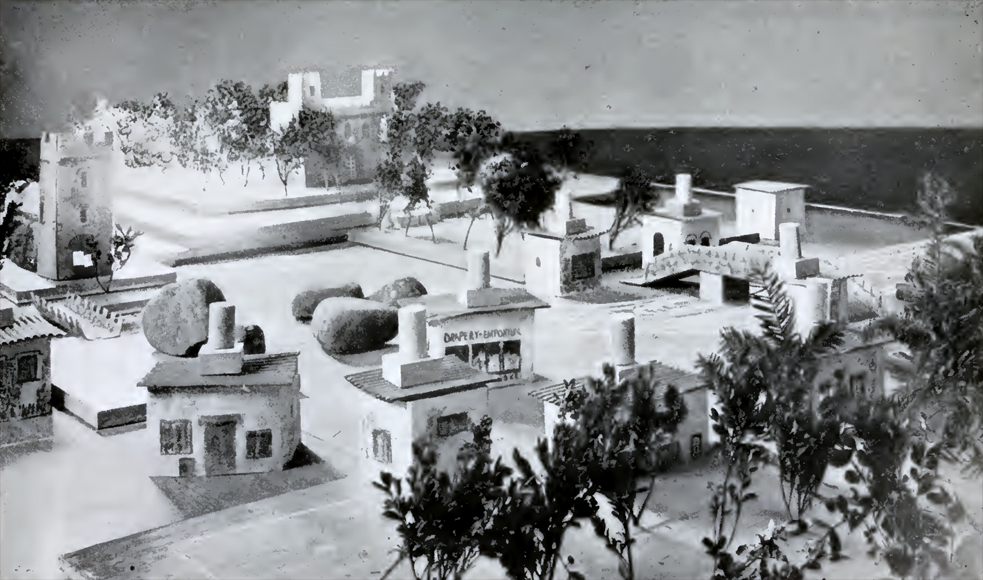
Advancing the different variety that could be made in battlefields (point out that if it’s too crowded, guns are ineffective and large open spaces make danger for troops), it was decided that one player should plan and layout the country, and the other could choose from which side to play. They had to add some new rules like Houses and sheds being solid lumps and not hollow cause if soldiers could be put inside it created complex situations and then adding more rules via play-testing. Combat was adjustive and.. well.. you probebly get the idea.. He spend a fair bit of time explaining how it evolved into the game being published and why with great photos of games in play, tables and stuff.
So lets all skip now to the Rules. While the Book is public domain (There has been the odd republishing of it though) I won’t go into all the rules one by one but I’m sure any wargamer will recognise soo much of this.
Country – which is what they call the Battlefield. One player arranges it, it can be either decided before hand or with a flip of a coin. The other player then chooses which side of the field they will start from. As much as possible, no NOT disturb the country with each move. This makes sense.. you can’t move a house out of the way to get a better shot.
Move – After the country is set up and sides chosen the players flip a coin to decide who goes first. If possible, they say to hide deployment from the other player so you don’t know how they have it set up but not a big issue. Figures are started off on his ‘back line’. One player deploys then the other does unless a curtain is there to block view from the other. Each turn is then timed based on the force size. About a minute should be allowed for moving 30 men and a minute for each gun. As the men are killed off, turn time can be reduced. The player should stay behind his back line until allowed to move. This is a basic timing system used in some early games. A time keeper is used to say ‘Go’, give a couple of warnings where time is nearing the end and then ‘Time’ when it’s time to stop. There is then an internal between each movement turn to deal with any accidently falling over but this is limited. Guns can not be fired until after the second move by the first player (NOT counting the setup as a turn). After making a move, a player must move or fire his guns first before troop movement.
Mobility – Two pieces of string as a measuring stick to mark out movement length. Infantry-men may be moved up to a foot in each turn, Cavalry up to two feet, a Gun can move based on the men around it. Atleast four Cavalry men means it can move 2 feet, if Infantry only one foot. Men must be within six inches Else it can’t be moved or fired. In each time, a Gun can either move OR fire but not both. If it fires, it is allowed up to four shots in turn, and can be swung around it’s middle axis and be elevated or depressed. Soldiers at it may also lay down to make it easier. Soldiers in front of fire of their own guns may lie own while wile it fires overhead. At the end of the Guns move, it must be left without altering it’s elvation and pointing. After Firing, two men must be put exactly at the end of the trail, one on either side. If it moved instead, atleast four men with it have to be placed within the six inches of the new position. When you place troops, they must be fairly clear of hills, buildings, trees etc. They cannot be jammed into interstices and there should be about one-sixteenth of an inch gap between men and anything (like buildings, other men, trees etc). When Men are knocked over by a shot, they are dead. If the shot knocks over more then one, then more then one are dead. IF it sticks a man but does not knock him over, he is still dead IF it hasn’t killed anyone already. A shot cannot kill more then one man without knocking him over. If hits but doesn’t knock over a few, the first touched is dead, the others are fine. Even if the shot has rebounded from an object and hits the feet, it still kills them in the same as the above rules.
Melee – If a man is on his own or it’s a group that is less then half of the total side’s number is more then one move away from more men, it is isolated. If it’s within 1 move of enough troops, it’s supported. When a Man moves up to another (one-eighth of an inch of closer) man of the opposite side, they must end there move and a melee has started. At the end of the move of both players, they examine the melee’s and work it out the situation. If there are equal amount of men on both sides, both sides are killed. If they are unequal, then the inferior force, if isolated take prisoners based on the number of men the inferior force is less then the superior force. Then the rest each kill a man. This is.. a little odd to understand the wording (yay, Wargaming rules), but .. IF nine are vs Eleven, then the eleven side takes two prisoners and each side kills seven, leaving the Eleven as Four men with two prisoners. IF the inferior force is Supported, then each man of the inferior force kills a man of the Superior force, but is then killed himself. So in this example, both sides lose nine. so all that’s left is two of the Eleven.
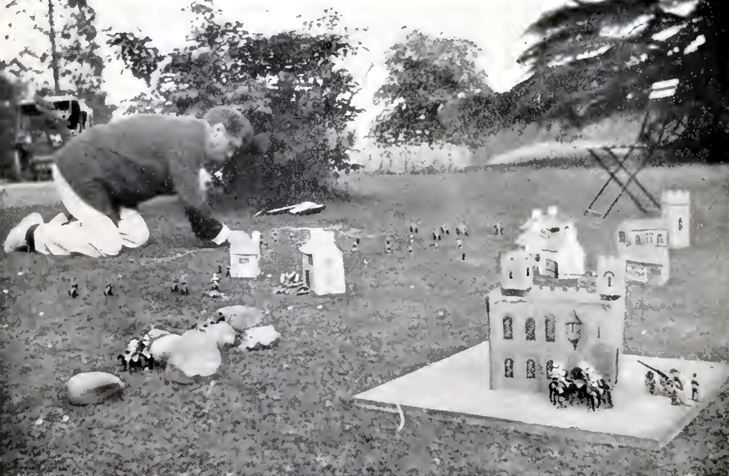
There are some more melee rules on prisoners and stuff too. Basically about escorting the prisoners to the entry back line. however, If the escort (within 6 inches) has been killed, they are liberated. However, as they have been disarmed they cannot fight until they are rearmed. In order to do that, they must reach their own Backline, at which point they can then be moved back into the battle. As Prisoners cannot fight back until they are re-armed, they are recaptured if gone into melee. At any time, any isolated body may hoist the white flag and surrender so.. I think they are then classed as prisoners. Doesn’t quite say ^_^ also typical of war gaming that. You can also capture a Gun when there is no men of it’s original side within six inches of it but atleast four men of the other side who have moved up to it and passed it’s wheel axis. When a gun is fully captured, you can use it for your side. Nothing better then turning the enemy guns on themselves.
Then they are types of Battle-games to play. ‘Fight to the finish’ where you need to capture, kill or just drive the enemy forces completely back over. You could also play this mode for Points with 100 for victory, 10 for every gun you hold or about to take, 1.5 for every cavalry-man you have, 1 for every infantry man still alive and uncaptured. half a point for every man of yours prisoner in the hands of the enemy and half for every prisoner you have taken from the other. IF the battle is still undecided when both sides are below fifteen men, then the battle is called over and the 100 points for victory are divided, though as you can play with any size force, if it’s less than 50 a side, the minimum is 10 a side.. “Blow at the Rear”. The game is won when atleast three men of one side reach any point on the enemy’s back line. When this happens, the enemy has a strategic defeat and his entire force must retreat over his back line within six moves. Anything left on the field after six, goes to the victor. “Defensive game” has one side as defenders, who are two-thirds the size of the attackers. These must stop the attackers from arriving while the Attackers need to get atleast a quarter of it’s forces to the defenders backline.
They then talk about setting up the armies. apart from any special cases (like the Defensive game), have equal size forces. But you can set up a slight inequality by having twelve figures on each side taken out and then each player rolling 2 D6 to see how many of these 12 they get back. There rough army list is small bodies of about 20 to 25 infantry-men and 12 to 15 cavalry to a gun. This gives a good front of about 4 or 5 feet. Most of the games Wells played as about 80 Infantry, 50 cavalry, 3 or 4 naval guns and a field gun on each side. There is also a points system which can be used. 1 point for each infantry, 1.5 for each cavalry, and 10 for a gun. this could be done for a 150 points a side giving more variation. A Boer-like set up gave a cavalry force of 80 with 3 guns being defeated by 110 infantry with 4 guns.
He then talks about the size of the soldiers. They should all be to scale with each other, saying the best British makers have standardised sizes with infantry being nearly two inches tall, but there are also lighter, cheaper makes which are perhaps and inch and a half tall, while Foreign-made soldiers are of variable sizes. 2 Inchs is about 50mm, and 1.5 inchs is about 38mm. I guess most of us use Foreign made ones then the best British ^_^
What is next in this book? Why, a Battle Report! The Battle of Hook’s Farm is then described and more photos shown with some fluff added to make it being giving in-character As General H.G.W. of the Blue Army fights, with photos by woman War-Correspondent A.C.W. ‘a daring ornament of her sex’ (That is Amy Catherine Wells Nee Robbins. She was a student of Wells as a writer an a poet herself, and they got married in 1895 until her death in 1927 at the age of 55. They had two children, George Philp and Frank Richard Wells.)
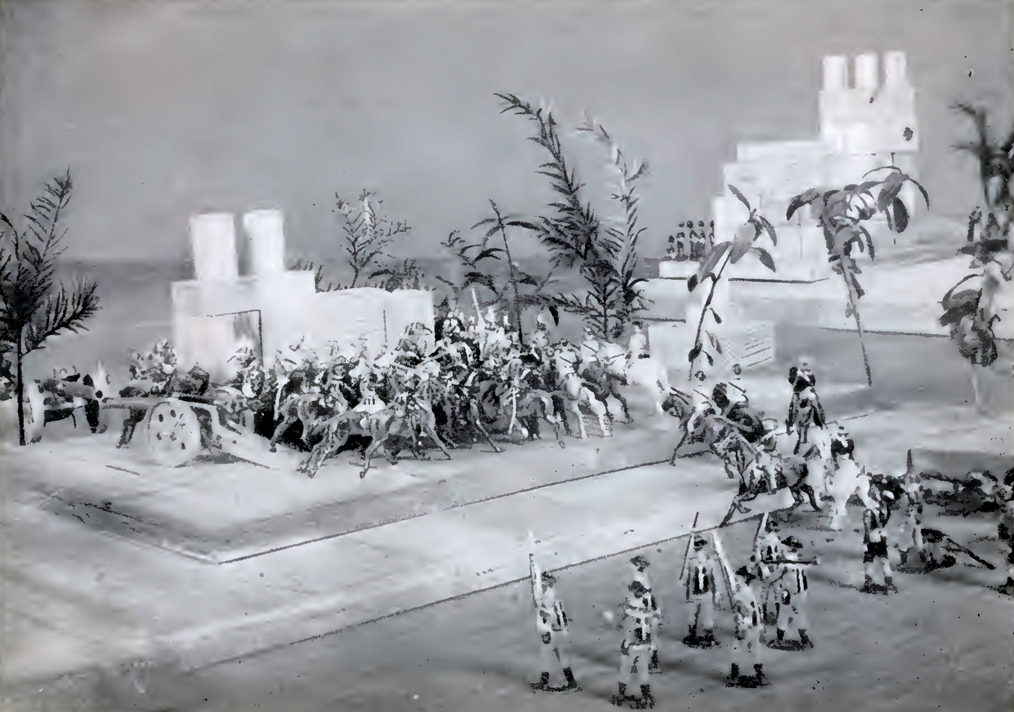
After the Battle Report, it then talks about how to expand the game. why not more then 2 players? many hundreds of soldiers. Bigger floor space makes a bigger battlefield. Why not use smaller though? Also, keep some figures in the boxes with the lids on, moving the boxes as a unit so the enemy would could move for a while hidden behind the scouting party until revealed. Why now expand with army service waggons? Why not Campaigns where you can have divisional commanders and batteries of guns. Why not a toy railway with stations or rolling stock on which troops might be put on.
He ends up with bits about saying that he sadly doesn’t have enough time to work on expanding the game like this, but also does not have enough friends who know the rules to have multiple players per side games. The Battle of Hook’s Farm had only 2 players and took a whole afternoon, while most of his games have taken the better part of a day.
Well, I say he ends it up there.. he does end with a challenge. He was the chief inventor and practiser (so far) of Little Wars, so he wants others to work on it and expand it, playing more. As a pacifist, Wells does rightly point out how this is much better than the real thing. “Here is a homeopathic remedy for the imaginative strategist. Here is the premeditation, the thrill, the strain of accumulating victory of disaster- and no smashed nor sanguinary bodies, no shattered fine buildings nor devastated country sides, no petty cruelties, none of that awful universal boredom and embitterment, that tiresome delay or stoppage of embarrassment of every gracious, bold, sweet, and charming thing, that we who are old enough to remember a real modern war know to be the reality of belligerence.”
“My game is just as good as their game, and saner by reason of its size. Here is War, done down to rational proportions, and yet out of the way of mankind, even as our fathers turned human sacrifices into the eating of little images and symbolic mouthfuls. For my own part, I am prepared. I have nearly five hundred men, more than a score of guns, and I twirl my moustache and hurl defiance eastward from my home in Essex across the narrow seas.”
“You have only to play at Little Wars three or four times to realise just what a blundering thing Great War must be.”
There is a small appendix on a later reprint which gives a tiny bit more on it’s relationship to Kriegspiel and some extra rules like Royal Engineers, passing rivers, making charges, loading and unloading into boats, destruction of railways bridges or bits, building entrenchments and a few other bits.
I’m not 100% sure why Little Wars isn’t recognised for what it is more then it is, but I guess it might be in some spaces of the world as.. Its a book by H.G.Wells, and it’s on Miniature gaming.. Why would that be ‘rare’ and unknown?. Oh but forgive the photo quality..
While I didn’t notice it in this book, I’ll point out a famous line by H.G. Wells about miniature gaming: “Wargaming is Chess with a thousand pieces”.. though I might have the exact wording slightly off.
Well.. bringing back to the start.. Attactix is a much simpler game but I think with knowing all this, we can now talk about that next game.. Which will be Part 2, As I remember it and was really into it when it was new, I can also tell a bit of behind the scenes, to a degree, of what was going on and why it was ended.. sadly.
