
Home Casting
While it’s always kinda nice to get a professional release miniature or thing, I like home casting because it’s.. kinda easy but also hard and not as pricey as you might think, though not always the cheapest option.. So yeah, very mixed bag but fun.
I would say there are really 3 main home cast options when it comes to materials and there are better people out there with far better information on various bit and pieces but I think I’ll just give some of my experiences and information cause that is mostly all I can give.
Other then the 3 material options are Metal, Plaster and Resin. Are there others? well.. yeah.. Silicone is an option but for Miniatures? you probably don’t want to cast in silicone. There are also a few options for the moulding which I’ll get into.
There are also kinda 3 sources when it comes to moulding. Professional moulds, self-made moulds and slightly iffy self-made moulds. Don’t know if this is a good naming system cause the last two are kinda the same but not. as the 3 material options are equally valid for the 3 ‘sources’. Lets talk about the sources first.
now, while you might think I mean what the moulds are made from, I’m not. Lets see what I’m talking about:
I) Professional Moulds. What I mean here is you can buy moulds for home casting. Companies like scenery forge (http://scenery-forge.com) sell moulds for mostly scenery but also figures made from Silicone for mostly Resin but can also be plaster casting. These are mostly 1 part moulds which are the easiest to make anyway, and they are from professional sculpted models. Personally, I think as the 1 piece moulds I’ve seen often mean you need to cast things like the body in 2 parts (front and back) or atleast appears that way, I think that’s a bit annoying.. trying to get the surface flat enough to put together isn’t impossible but.. adds too much extra work in my view. There are also companies like.. and by like I mean pretty much the ONLY one Prince August (http://princeaugust.ie) who do professional moulds for Metal casting. They have been around since the 80s and the moulds sometime pre-date that a bit but are kinda limited, but they are often pretty nice though there main focus isn’t miniatures, but they have a nice range even if limited. Just pay attention to if it’s an older 25mm mould or a slightly newer 28mm cause the 25mm figures are noticeably smaller. Unlike the silicone moulds, these are rubber/vulcanised in order to deal with the metal heat well. But either way, these are professionally made moulds from professional sculpted figures.
II) Self-made Moulds. These are when you have sculpted or otherwise made an item yourself and make moulds at home. now, some companies, like Macrocosm (https://www.macrocosm.co.uk) do offer a fair price mould making option so you can send your home-made stuff to them to get a professional mould made but really, if you are paying someone else to make a mould for you, I would expert you to be semi-pro atleast. So self-made ones you made at home from stuff you have made at home. This can be great fun. You are unlikely to make vulcanised moulds at home (unless you run a home business in making such moulds but then.. you would come under professional level). The most common material for making moulds at home is probably silicone. It’s fairly cheap, fairly quick, fairly easy. While I say probably… sigh, I’ve had a couple of moulds of late which just failed to set making a bit mess. or kinda set but really soft.. poor mixing on my part. I’m not expert. Most likely your home moulds aren’t gonna be perfect. Even if you have some understanding of pour holes, air channels etc, you might just not get things perfect. Also if you have to do a miniature which requires a 2 part mould.. ugh.. I don’t think I’ve EVER made successful two part mould. With Silicone being soft you can do a 1 part mould which you half cut in half to make a two part with a ‘rubber hinge’ of sorts. probebly the better way to make a 2 part silicone mould.
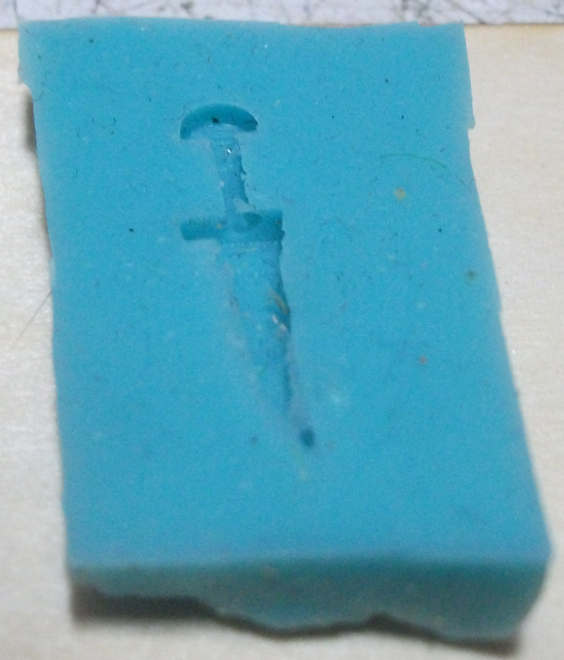
III) Slightly iffy self-made moulds. yeah.. erm.. like self-made moulds, you are making these at home but this is about the ‘source’.. the source in this one isn’t stuff you made yourself, but stuff other people made. Mostly, this is kinda ranging from iffy to out and out illegal. If you like miniatures from a company they are still in business, why are you making home moulds to copy there work which you can buy? cause it’s cheaper? maybe but you think the company is gonna keep being in business if you rip-off there stuff like that? There are times when you might want to do this and do it and in some parts of the ‘antique’ field, restorers will make a mould and reproduce a part to restore an item but.. it’s complex and the laws are also complex. For home use only, It can sometimes be a good practice method. If you have an item which is professionally made, it can be easier to make your own mould if you know it came from one so you can focus more on working out the pour holes and air channels more then something you have sculpted and you see its not gonna cast in one piece cause you didn’t know how to sculpt it at first. Some small time soap sellers (like on some.. partly iffy sites) like to take a object someone else made, make a mould and then cast it as a soap and sell it as a original home-made item.
But really, I think there three sources for your moulds (professional made, home made and home made from Professional made stuff) are basically the three types you are gonna have. Now, the three materials for home casting which are most likely to use
I) Resin. Resin is probably one of these ‘most common’ ones for home casting stuff. Resin can be a pain depending on the type, and there are plenty of flaws in it, but it’s fairly cheap and common. If you make your own moulds, you need to think about the air bubbles.. you WILL get air bubbles.. even alot of professional resin casts will get air bubbles (even if they are internal so you can’t see them) cause resin is a nightmare. Often have long casting times, though depending on things, you can get quicker setting stuff but I believe the quicker it sets, the more chance of air bubbles cause it doens’t have time to remove them. You can buy resin which has stuff designed to get out the bubbles but you will still get some, mostly if you are using a 2 part mould or a self made mould. If you are doing Scenery or anything which has a big flat surface you will have less air bubble issues but if you have any bends or areas where some air can get trapped, it WILL at some point.
II) Plaster. Mostly Plaster of Paris but.. well, if you are of my age, you will have used Plaster of Paris in casting some stuff, probably at school but mostly at home. That’s cause when I was young, there were TONS of home casting plaster of Paris kits around. These often were made of.. I think a Latex seeing as how they degrade after time but I got a nice Cat one which when I was young, I cast and painted up as my first cat, I had a Teenage Mutant Hero (UK) Turtles set which I think atleast one is still useable. A friend or more parent I think had some Beatrix Potter ones and that artist/style which there are still birthday cards and stuff in.. pass at the name but still common. I still have some casts with iffy child painting. While I did often just think of Plaster of Paris as a childerns casting material, depending on the type you get, it can be VERY solid and you can buy garden statues out of the stuff. While I’m not 100% sure on castings Miniatures out of it, It’s no problem for Scenery items and fairly easy and quick (a bit messy with the powder and all) though getting the right mix of plaster to water can be fussy but it’s not hugely important. Often if it’s too wet it’ll just take longer to dry. One also advantage of plaster over resin is you can kinda reuse it. with resin, the off cuts and pour channels are waste. with plaster, to a degree just make it back into a power and reuse it. I’m not sure HOW well this works cause the chemical reaction and all but.. meant to be perfectly fine and really cheap for home casting.
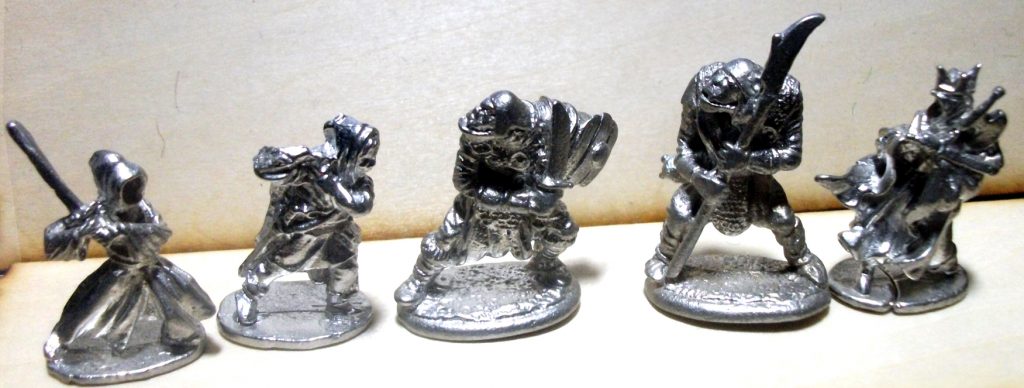
III) Metal. Ah, the fun one (as a burn mark on my foot can tell ^_^). You more often need a professional mould as.. well, a good mould made for metal casting will get you about 500 casts. a home made Silicone made? maybe 50? maybe less. but nowhere near as much. Still, depending on what you want and why, it’s fine. Metal casting is slightly harder I think but not by much. Instead of mixing two-parts of a resin together, or powder with water, you need to mix Heat with metal. Depending on how much you are doing, the simple way is heat up metal to about 300C (or up to 350c. If you want 300, most likely use a home oven hob, if you want to do more, use a proper heating pot/crucible which can do hotter), you can pour the metal into the mould, wait for it to cool down (my advice is wait for it to go solid on the top, then wait a few minutes before demoulding) but within 5 minutes, you will most likely be able to take the models out of the mould and do another cast. Nice and quick and you get a nice metal mini at the end. If it’s a bad cast? put the metal back into the pot or whatever you are using and metal it down again. There is some tiny waste but not alot. Metal is much heavier and there are more risks. Just if you are sensible, not a huge amount (minor burns aren’t serious). Problem does come with Professional moulds.. For home-casting Metal.. Prince August is about the only company you can get moulds from. So that’s a huge limitation. But for small runs, like I said, home made silicon moulds are fine.
Price wise for home casting.. Mm.. Resin is probably the most expensive for short runs, for Long runs, Metal is probably the most expensive because of the mould making. If you can only get 10 decent casts from a home silicone mould (I think it might be more 50.. but I’m not sure) compared to 500 with a professional mould, then you need to spend far more money on the moulds for Metal then Resin. As Prince August kinda have the market on home metal casting for amateurs, I get my metal from them (I’m kinda sure I might be able to get the same metal from some professional metal guys for probably cheaper.. hard to say cause it might need to be in bigger bulk, but I used the ‘6 star metal’ which for better or worse is a Lead free low melting point Tin Bismuth Alloy, a bar of which is about 100grams which will do roughly 10 28mm basic figures is £6.02. So you have 60pence a figure. Bit more then 80s prices but not bad. Due to the lack of Lead (kinda) this metal is pretty hard so you can’t bend arms and stuff. If you want some nice lead in your minis, they do a ‘Model metal’ which is in fact, meant to be better casting.. I might wanna try it out sometime, and a bar the same size is £4.55 (unlike the 6 star which is Tin and Bismuth, this is just over 50% lead, with tin and Bismuth). These do give some bend and probably a better metal to use for minis really.. really must try it out. It’s just I got a kit to start with and that had 6 star, so I kept with what I know ^_^ Need to talk to others about pros and cons of metal types.. a Bit out of my field.
The way the moulds are used is also fairly interesting to how the mould should be made. The Metal casting is often referred to as Drop Forge (or just Drop) casting (well, the home stuff cause you probably don’t have a pricey spin-caster at home). This is also the kinda thing you will see in old movies of medieval casting as you have a mould where you pour the metal into the top, directly above it, and then when cooled, open it up. Oh and as I might as well, Spin casting, which is the way MOST professional metal casters will used for miniatures, put a mould in a form or vice to hold it together (kinda do the same with Drop forge casting too) then you spin it around at speed and pour the metal into the middle of the mould. the erm.. I can’t remember the term but lets say ‘force’ of it spinning around helps pull the metal to the edge of the mould like a windmill so it flows well. the Air is kinda forced out this way, where Drop forge, it’s the weight of the metal pushing down which pushes the air back out the metal pour hole. There are pros and cons of both methods.
Resin also uses drop forge casting BUT you kinda need to have a couple more air channels because the resin isn’t heavy enough to push out the air, so you need someplace for this air to go. Often you should have one large pour channel, and a couple of smaller air holes. When you pour resin and it starts to come out of the air holes, you have more then enough in there. Plaster is also drop-forge .. but.. I’ve only really known it with a large opening or flat surface on top. I have cast up a custom action figure head before (and you don’t want to cast small stuff with plaster cause it’ll snap really easy) but it’s best for something like scenery stuff.
I have been interested in a couple of other methods.. there is a kinda home ‘injection moulding’ method.. Injection moulding is how most plastic figures are made. you often have a huge pricy metal 2 piece mould, you then inject plastic in one hold for it to push out the air (or pull out the air on the other side). There is a way to kinda do a home version I’m kinda interested in for fun but you aren’t gonna really make a metal mould at home. There is also a way to do plastic in a drop forge way if you use a low heat or thermal plastic like a PTA cause it has a low melting point so you can pour it into a mould. Its probably a bit lower temp then metal so might allow more casts but.. plastic is normally not where near as good at catching details so results in softer figures. They can be pretty good and crisp but on the whole, softer. Also plastic prices are.. probably mid way between resin and Metal.
Don’t know if I said, but one thing that annoys me is as a buyer, Metal minis are the cheapest and best quality, Plastic is normally higher price then metal due to the setup costs, and softer details, Resin has cheaper setup but most pricey material so the most pricey figures to buy with none benefits. So why companies love to make resin minis when it would be cheaper for them, the customer and better in the long run to make metal? no clue. When it comes to BIG figures… Unless you want a lot of pieces, I can see why Resin is a go-to material. While I’m sure some companies might sell spin casters which can do HUGE figures, it’s gonna be a bit of a bugger. Talk to some experts who make professional stuff more then some Random Idiot like me.
So.. That is a bit of a chat on home casting. There are often methods, Sand, Clay & Alginate are also mould materials you can use at home. Metal moulds are less likely for you to make at home.
