
Battleground – a nice Failure
In 1978, Wargaming fan and talented known actor Edward Woodward was the host and probebly co-creator (all known things would say he may have been) of a TV show called ‘Battleground’. It was created to share the hobby of Wargaming with the public but it appeared the public weren’t that interested. It ran for only 1 full series (6 episodes which was a standard UK series length) and took over 5 months partly because of how long the large battles took to play.
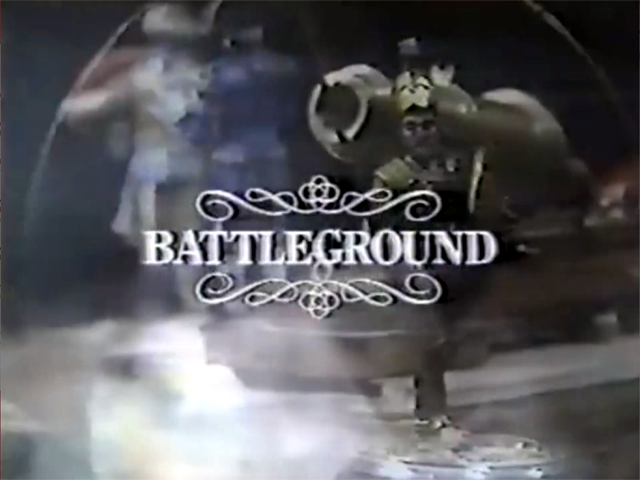
Each battle was based on a historic or semi-historical battle fought using 25mm miniatures mostly supplied by Peter Gilder, with Terrain also created by Gilder, though some episodes had figures also supplied by Gavin Lyall, John Tilson & Phil Robinson,. The Rule set was mostly George Gush’s Wargame Rules for Fifteenth to Seventeenth Centuries with some additions such as Peter Gilders rules for Napoleonic Artillery. Due to the shows Half-hour format, the Battles were more ‘highlights’ with Mr Woodward not only narrating, but giving comments during them. While they weren’t “faked” battles, the show which was basically a battle report, did have some.. kinda pre-arranged bits like knowing who was meant to win, so for the other player to not quite play as their best, atleast that’s what I’ve been told, without contact with anyone involved, it would be hard for me to say.
It was quite a laid back show which may have been one of the reasons for the show not doing too well as people probably got bored if they weren’t interesting in the hobby to a degree. There were kinda hints that a series two would feature probably some other settings such as fantasy or sci-fi but this is far from a known fact. Another nice point for the show was each battle, it gave the historical context and some account of what happened. Sometimes some events lined up pretty well to history, others the complete opposite.
The first episode featured the battle of Edgehill, which was a key battle in English, 1642 between the Royalists and the Parliamentarians. The Royalist were commanded by Duncan MacFarlane with figures supplied mostly by Peter Gilder and Phil Robinson, and the Parliamentarians were commanded and supplied by John Tilson. Episode two featured the Battle of Waterloo (1815) with the English being commanded by John Braithwaite (who did a fair bit of work for Minifigs) against the French commanded by Peter Gilder. The third episode was the Battle of the Nile (1798) which was the British vs the French with Steve Birnie and John Harrison commanding the armies which they supplied there own figures. the Fourth was the Battle of Chalons Sur Marne (451 AD) between the Romans, commanded by Steven Davidson, and the Huns (mostly) commanded by Bob O’Brien. Episode five featured Father and Son Gavin and Bernard Lyall battling against each others in 1944 France in another fictional battle, just after D-Day. The final episode was then Gettysburg (1863), with the Union forces lead by Dr Paddy Griffith and Peter Gilder returning to lead the Confederate Army.
Like I said about, the show’s failure was probably due to a few factors like it coming off as a bit slow. It is basically an animated Battle report, complete with diagrams of the troop layouts and close up shots of ‘action’ at times. Edward Woodward is a great host who is clearly into something he highly enjoys and in fact, had a pre-association with Peter Gilder. When doing Callum, a TV show in which Edward Woodward plays Callum, a slightly morally iffy good guy who’s main passion was miniature wargaming, often sitting in his flat painting up his troops. In the movie, he visits a wargaming convention where the figures and terrain were supplied by Peter Gilder. After filming, Mr Woodward wanted to buy both the terrain and the figures, but Mr Gilder would only sell him the Terrain. It was this Terrain which was then used for the Battle of Gettysburg. And no.. I have no clue what happened to it after Mr Woodward’s death in 2009. shame, Would love to see his collection in a museum or something ^_^;
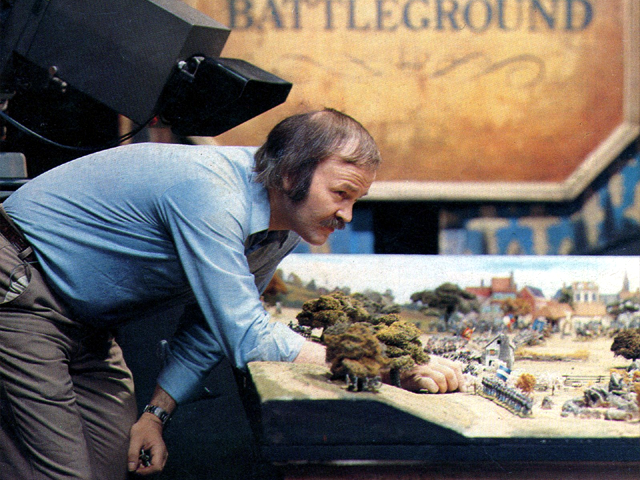
The show was produced by Tyne Tees Television which, was of course a North East England producer so was most likely only shown in that area (not that Tyne Tees Television Shows were only shown there but yeah.. It is also of note that Duncan Macfarlane and John TiIson were both from the Hull wargaming club, John Braithwaite was ‘from Hull area’, Steve Birnie and John Harrison were from the Halifax gaming club. It also appears that the France 1944 D-Day game used ‘Operation Warboard’ rules which were written by… Gavin Lyall!
Sadly the show didn’t last long as no series two happened and they have never publicly released episodes on DVD or VHS or Bluray or V2000 or Betamax or Laserdisc or CED or any other format you can think of. you can find about 4 of the 6 taken from off-air recordings but that’s it. Since they most likely ONLY aired once back in 1978 it’s fairly lucky that much survives right now with real extra inform from an article in the short lived wargaming magazine ‘Battle for Wargamers by now dead Terry Wise, who was a big-ish guy in the wargaming field at the time (he also owned a book shop in Doncaster) and an article in the TV times. Funny enough, they also do comment on H.G. Wells so that ties in with my last weeks post (and part 2 is coming when I get around to some stuff).
It’s quite interesting that some contemporary articles point out that the 6 battles are each from a difference type of game.. in a way. Ancient, English Civil War, Naval, Napoleonic, American Civil War and World War 2. The idea to get people interested in the hobby and the range of battles, which probably ties in with the comment about Sci-fi and Fantasy settings
OH and minor side note. Tynes Tee Television is now owned and part of ITV, where it is now an inhouse ‘ITV Tynes Tee’ studio. Its quite likely the Episodes exist in the ITV vast vaults. If you happen to work for ITV or a third party company that is related, you can sign into the ITV archives and atleast check if it is..

Didn’t know that was a thing, how interesting. In the late 90s or early 00s there was a similar thing but using computer game style digital simulations. Not as fun as this, but interesting watch.