
Dungeon Bash Quest over and over
Okay, now this isn’t some complete in-depth research post.. though that would be fun but a bit more light hearted thinking about things and looking at some of what I believe were attempts (both successful and not) of doing something.
In 1989 Games workshop (with publisher Milton Bradley) released Dungeon Bash game ‘HeroQuest’ with expansions being release twice in 1989, once in 1990, twice in 1991 and once in 1992. The American Port of the game didn’t issue all this expansions but did release 2 exclusives in 1992, and two were planned for 1993 but were unreleased.
Also in 1989, Games workshop released an expanded version of Heroquest (in a way) entitled ‘Advanced HeroQuest’ which was closer to WFB structure, but only had 1 luck-luster expansion in 1991.
However, for some reason, they didn’t wanna let a dungeon bash game die.
Well, that said, It didn’t START for GW with Heroquest..
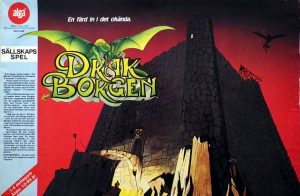
In 1985, a swedish game ‘Drakborgen’ [Dragon Castle] was released where players try to go in and loot Dragonfire castle (shouldn’t it be Drakeldborgen then?). In 1987 GW got the license for an English version which they called ‘DungeonQuest’, and released 2 expansions for it (both in 1988, one being a miniature expansion pack to give new heroes, another being new gameplay settings).
DungeonQuest can clearly be seen as one of the stepping stones to Heroquest. They even loved the ‘quest’ nature being front and centre.
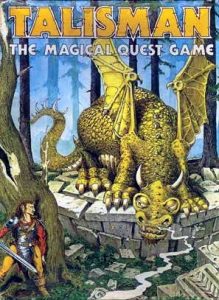
Another would be Talisman. This game was first published in 1983, before DungeonQuest. In 1985, it was expensed to the second edition which replaced the card miniatures with metal ones. This also had a number of expansions twice in 1986, once in 1987, once in 1988, once in 1989 and then once in 1993 (weird gap eh?) then in 1994, they issued the third edition with 2 expansions that year and one in 1995. They later did a 4th version in 2007. Like DungeonQuest, Talisman wasn’t a GW product at first. It was created by Robert Harris, with the name Talisman, and GW had a royalty publishing contract with Harris until 1994, when they brought him out completely and took full control, which might explain part of the stopping of support in favour of their more ‘original’ works. Later when the 4th version came out, GW had moved to sub-licencing so it was Fantasy Flight who released it, and later still, Hasbro (via Avalon Hill).
As I pointed out, the 1994 date is quite important. It may have been the 1993 date where they really brought Mr Harris out for a 1994 release, which would explain the big game for that expansion, but after releasing the new version, they pretty much dropped it in favour of their new ‘totally GW’ dungeon bash game. It was kinda a follow up from Advanced HeroQuest. As they loved the Quest part of the title (say what it is in the title, it’ll help), they named the new one, Warhammer Quest. This however, was a bit of a cheap release as pretty much all the base set plastics were pre-made citadel Figures. In fact, lets take a quick check of the Miniatures.
- Creature Sprue featured 4 small creatures. A Snotling, a Giant Bat, a Giant Spider and a Giant Rat. There were original to this set.
- The Goblin Sprue contained 4 smaller sprues each featuring one Goblin with Spear, one Nightgoblin with Bow and one of a few shield designs. This was first released for WFB 4 as ‘Goblin Spearman & Archer plastic set. Originally released in 1992, and later in a box set in 1996 as ”Goblins’
- The Orc Sprue was like the Goblin one, with 4 smaller sprues featuring 1 Orc Warrior, 1 Archer and a shield of different design. These were also a 1992 release which were later reissued as a 1996 Boxset.
- The Skaven Sprue featured 4 of the same Skaven clan rat with one of a series of shield designs but appeared to first have been released for the 3rd Edition of Talisman, before being used for WFB 4.
- 2 types of Minotaur were included. Minotaur with Battle Axe and Minotaur with Club. Both were originally released with Talisman before the Warhammer Quest release.
- There were original Dungeon Doors which also were used as clips to hold each room tile together.
- 4 Heroes were included on the Hero Sprue, using the now classic 4 of a Barbarian, a Dwarf, an Elf and a Wizard. These were original but it is interesting to note that the Dwarf sculpt was very clos to the advanced HeroQuest Dwarf in pose and equipment, though replacing the warhammer with an Axe. The Elf was quite an original pose and clearly a wood elf, compared to the more high elf which was used in previous games (though Talisman did used a wood elf, it was more of a less ‘wood elf like’ design and was similar in pose and equipment to the Advanced HeroQuest Elf. The Wizard almost appears like an alternative design for the Talisman Wizard, both with the same style of pose, outfit and equipment, which was noticeably different from the HeroQuest and Advanced HeroQuest Wizard, as it has both a Staff and a sword, instead of just a staff. As for the Barbarian well.. The Talisman Barbarian (called warrior) was more like the Heroquest Barbarian then the 3rd edition Talisman Barbarian on the cover. However, the Warhammer Quest Barbarian was kinda a bit closer, though was clearly the one from the Warhammer Quest Cover (why, oh why, did Advanced HeroQuest have the Barbarian front and centre and yet, didn’t include one?)
Of course, we have to talk about the cheap 1991 releases where due to the cost to get plastics made, they made simple games which re-used the same moulds, or in some cases, just overstock.
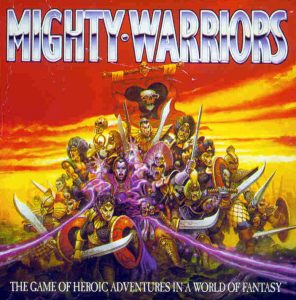
The one important to this is Mighty Warriors which was released in 1991 and reused all the Advanced Heroquest miniatures with the Warrior and Dwarf shields now being used as tokens, and the Wizard now being a Chaos Wizard. Even the card dungeon tiles were re-used from Dungeon Floor Plans sets and Warhammer Fantasy battle scenario packs.
While HeroQuest was clearly set inside the Warhammer Fantasy Battle world, it was more Warhammer Quest that made the connection to be a main point (in fact, the taglines show this with Warhammer Quest being ‘Dungeon Adventures in the Warhammer World’).
Part of this evolution may be tied to the state of Games Workshop and its marketing ideas. Early on they were publishing other peoples board games as more of a niche thing, though they did do some of their own small games, they then teamed up with a larger publisher (Milton Bradley) which gave them more exposer on the high street to the average person (and the parents of young teens) which gave them what they needed, and probably even some relationship with retailers to allow them to self-publish high street board games.
Of course, it appears that GW has lost these links today. GW don’t release as much stuff, they are closing their own stores and just having to go back to third party gaming shops and online (and they have been really annoying the third party gaming shops alot of late .. well, for years, but it’s been getting REALLY bad if you know much about your gaming shops). Once in a while they try to get a foot in high street stores again with the odd ‘part-works’ series but ultimately, they have gone back to a small time niche hobby line then their height of success in the mid 80s to early 2000s. There current attitude of the ‘brand name has value’ to the degree of charging twice the price for the goods compared to the next leading manufacture (with less of a brand name) doesn’t help them much either.
